
Regulation isn’t about keeping a lid on things. It’s about expanding what you can actually be present to — and that changes everything, in every part of your life.
Containment works, up to a point. The presentation gets delivered. The difficult conversation gets navigated without visible damage. The professional surface holds. What it costs is another matter — because the feeling doesn’t resolve. It goes somewhere else. Into the body, where it accumulates as tension and fatigue. Into the relationship, as distance or resentment without a clear address. Into the next interaction, where it arrives as an edge nobody can quite account for.
And containment is not just a work strategy. It runs everywhere — in marriages and friendships, in parenting, in the private experience of being alone with yourself and finding that the feelings you’ve been managing all day are still there, waiting. The person who keeps it together at the office keeps it together at dinner. Keeps it together in the argument that never quite becomes an argument because one person always steps back first. Keeps it together until, at some point, keeping it together stops being a choice and starts being the only available mode.
Real emotional regulation is something different — and something considerably more useful. It is not the management of how you appear. It is the expansion of what you can actually be present to.
The window of tolerance
The concept of the window of tolerance, developed by psychiatrist and clinical professor Daniel J. Siegel — whose work at the intersection of neuroscience, psychology, and human development has shaped much of what we now understand about emotion and the mind — offers the most useful frame for understanding what regulation actually is.
The window is the range of activation within which a person can function: can think clearly, stay present, access empathy, respond rather than react. Inside the window, the full range of cognitive and relational capacity is available. Outside it, in either direction, something essential goes offline.
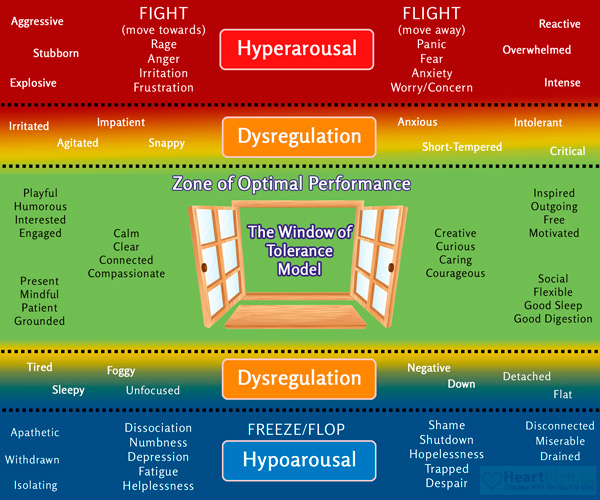
Outside the window on the upper end — what the nervous system literature calls hyperarousal — the system is flooded. Heart rate climbs. Thinking narrows. The prefrontal cortex, which handles nuance, empathy, and complex decision-making, becomes less available. What remains is fast, reactive, survival-oriented processing. This is the state in which people say things they regret, misread situations, mistake disagreement for attack.
Outside the window on the lower end — hypoarousal — the system has gone in the other direction: shutdown, numbness, disconnection. This looks like the opposite of reactivity — the person who goes very quiet, very flat, very far away. It is equally dysregulated, equally outside the range where real contact and clear thinking are possible. It is simply less visible, and therefore less often recognized as a regulation problem.
Emotional regulation, understood properly, is not about suppressing the upper end. It is about expanding the window itself — so that more of life can be experienced without triggering the system’s emergency responses.
Why the window is where it is
The window of tolerance is not a fixed biological given. It is shaped — by early experience, by attachment history, by the specific environment a person grew up in and what that environment required of them emotionally.
A child who grew up in a household where strong emotion was met with punishment, withdrawal, or alarm learned something specific: that certain feelings are dangerous. Not dangerous in the abstract — dangerous in the immediate, relational sense that they produced consequences. The emotional system, which is above all a learning system, drew conclusions and adapted. Certain feelings got suppressed before they were fully experienced. Certain triggers got associated with threat responses calibrated to a context that no longer exists.
This is not pathology. It is intelligence — the intelligence of a system doing its best to keep a person safe in the conditions it actually inhabited. The problem is that the system doesn’t automatically update when the conditions change. The window calibrated for a ten-year-old navigating a volatile household is still operating, decades later, in a boardroom or a marriage or a difficult conversation — responding to the present as though it were the past.
Understanding this changes the relationship to one’s own reactions. The flooding that arrives in a difficult meeting, the shutdown that follows a piece of critical feedback — these are not evidence of weakness or inadequacy. They are the nervous system doing what it learned to do. The question is not why am I like this. It is how do I work with this, and how does the window expand from here?
The patience problem
There is one expression of a narrow window that deserves its own moment, because it is so common and so rarely named for what it is.
Impatience.
Not the ordinary friction of a slow queue or a delayed flight. The chronic, structural impatience of someone who cannot slow down — who interrupts because waiting for the other person to finish feels genuinely intolerable, who moves fast in every context because stillness produces an anxiety that movement temporarily relieves, who is abrupt and sometimes cutting with people not out of cruelty but because the internal pressure to get to the point, to resolve things, to move on, is simply overwhelming.
This kind of impatience is often worn as a badge. I’m driven. I have high standards. I don’t suffer fools. I like to get things done. And there is something genuine in that self-description — the drive and the standards are real. But underneath them, in many cases, is a window of tolerance that has never been wide enough to accommodate the slower pace of other people, the ambiguity of unresolved situations, the discomfort of simply waiting.
The person who cannot listen — really listen, without composing their response while the other person is still speaking — is outside their window. The person who is routinely sharp with colleagues or abrupt with people they care about is not primarily a person with a character flaw. They are a person whose nervous system is running too hot for the situation they’re in.
Patience is not a virtue you either have or don’t. It is a capacity — and it develops, like all capacities, through the expansion of the window that makes it possible.
The Change Triangle: why emotions need to move
One of the most useful frames for understanding why regulation is hard — and what regulation actually requires — comes from the work of psychotherapist Hilary Jacobs Hendel, whose Change Triangle maps the relationship between core emotions, inhibitory emotions, and the defenses we use to keep both at a manageable distance.
At the base of the triangle are the core emotions: anger, sadness, fear, disgust, joy, excitement, sexual excitement. These are biological, universal, adaptive. They exist to give us information and to move us toward what we need. When they are allowed to be felt fully — when they can move through the body and complete their arc — they resolve. They do not accumulate.
The problem is that core emotions are frequently blocked before they can complete that arc. What blocks them are the inhibitory emotions — anxiety, shame, and guilt — that arrive in response to the core emotions themselves. If feeling anger has historically been dangerous, anxiety arrives the moment anger stirs, preventing it from being fully experienced. If sadness has produced shame, shame intercepts the sadness before it can be felt. The core emotion gets suppressed, the inhibitory emotion takes its place, and the whole system gets managed through defenses — the behavioral and psychological strategies that keep us from having to feel any of it.
This is the connection between emotional processing and emotional regulation that most frameworks miss. You cannot sustainably regulate what you have not processed. The person who is chronically outside their window is often not someone who lacks regulation skills — they are someone whose system is full of blocked emotional experience that is continuing to generate activation from the inside. The path to a wider window runs through the feelings, not around them.
How regulation actually develops
This is where most conversations about emotional regulation go wrong. They offer techniques — breathing exercises, cognitive reframes, the advice to pause before responding — as though the problem were primarily a skills deficit that can be fixed by adding tools.
The tools are not useless. A slow exhale genuinely does activate the parasympathetic nervous system. Naming what you feel genuinely does reduce its intensity. A deliberate pause genuinely does create space between stimulus and response. These are real effects, worth knowing and worth practicing.
But they work best — sometimes only — when the window is already wide enough to use them. When the system is fully flooded, technique is largely unavailable. The person who most needs to take a breath is often the person least able to remember that option exists.
What actually expands the window is something slower and less glamorous than technique: repeated experience of being in a regulated state, in conditions that gradually approach the edges of tolerance without exceeding them. A daily practice of attending to bodily sensation and naming what is present — done consistently, in the low-stakes quiet of a morning before the day asks anything — is not a small thing. It is training the nervous system in exactly the conditions where training is possible. That accumulates. It shows up differently when the stakes are high.
Coping versus developing
There is an important distinction that most approaches to emotional regulation miss: the difference between coping with dysregulation and actually expanding the window.
Coping strategies help manage activation in the moment. They bring the system back inside the window when it has gone outside it. This is genuinely valuable — a person who can recognize they are flooded and take steps before responding is doing something meaningfully different from a person who simply reacts.
But coping is not the same as growth. A person can become very skilled at returning to their baseline window without that window ever getting wider. The same situations continue to trigger the same responses, requiring the same management, indefinitely.
What expands the window is gradually, deliberately spending time at the edges of what can be tolerated — feeling the anger without acting from it, staying with the grief without shutting it down, letting the anxiety be present without immediately moving to solve or suppress it.
Not because sitting in discomfort is virtuous, but because it is the only way the nervous system learns that the discomfort is survivable — that being inside this feeling does not require emergency measures. This is slow work. It does not produce dramatic results quickly. But it is the work that means, six months or a year from now, that a conversation which would previously have been impossible is merely difficult. That a feeling which once required containment can simply be felt, moved through, and released.
That is what expanding your range actually looks like. Not the absence of difficulty. Difficulty, met with more of yourself present and available.